
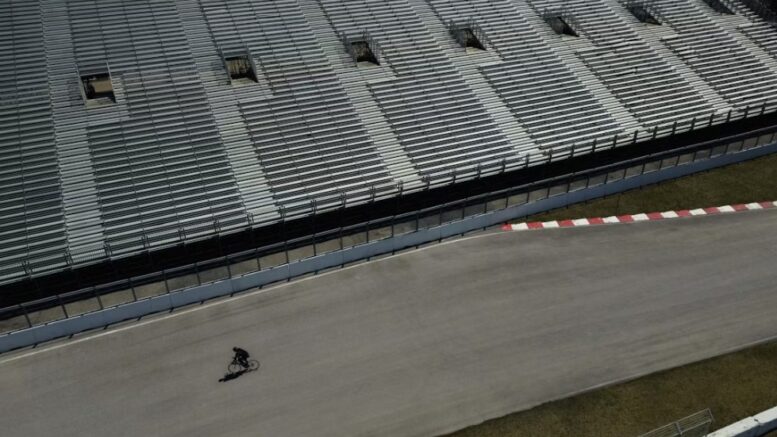
Circuit Gilles Villeneuve is famous for making world-class drivers look amateur. On paper, the island track looks like a walk in the park. You have massive straights where the cars hit top speed, a heavy hairpin, and a couple of tight chicanes to slow things down. That’s it. But anyone who understands racing knows the layout is an absolute trap. If you’ve ever watched a chaotic race play out from the grandstands at Parc Jean-Drapeau on a wet afternoon, you already know how fast this place can destroy a car.
The core challenge comes down to how the track is built and how it behaves over a race weekend. Because it sits on a man-made island and spends most of the year open to everyone local traffic and cyclists, the surface starts incredibly slick. It completely lacks the deep, rubbered-in grip of a dedicated European race circuit. When the F1 grid arrives, drivers are essentially dealing with a temporary street circuit masquerading as a permanent racetrack.
The Margin for Error in the Braking Zones
What really punishes drivers here is the stop-and-go nature of the layout. You are flying down long straights at well over 300 kilometers per hour, only to throw the anchor down for a tight, slow chicane. This constant transition from high speed to low speed requires absolute confidence in the brake pedal.
There is no margin for error when you drop the anchor in Montreal. At modern European or Middle Eastern circuits, a late braking point just means running wide onto a forgiving asphalt apron. Not here. If you lock the fronts for a fraction of a second at the end of the back straight, you are immediately a passenger heading straight for the grass, the gravel, or a very solid concrete barrier.
Riding the Curbs at the Chicanes
To set a truly competitive lap time in Montreal, you cannot afford to be timid. Drivers have to attack the curbs aggressively, quite literally launching their cars over the apexes of the chicanes to straighten out the racing line as much as possible.
This is where the engineering setup of the car becomes a delicate balancing act for the teams. Engineers have to run a softer suspension setup so the chassis can absorb these massive curb strikes without destabilizing. If the suspension setup is even slightly too stiff, the car gets deflected into the air, losing all tire contact with the ground. Once a multi-million-dollar racing machine is airborne, the driver becomes a mere passenger.
The Unforgiving Wall of Champions
If you want to see where a driver’s day completely unravels, look no further than the final chicane. Blasting out of Turn 14 puts cars dangerously close to the infamous concrete wall on the edge of the track. It’s a ruthless stretch of real estate that has swallowed up some of the absolute best to ever do it, including Michael Schumacher and Jacques Villeneuve.
Because the geometry of the curbs pushes the car outward toward the exit, drivers must flirt with the wall to maximize their exit speed down the front straight. It is a mental battle of millimeters. Predicting a completely clean weekend here is next to impossible, carrying a chaotic wild-card energy that mirrors other major global sports events. Trying to accurately guess the podium finishers in Montreal feels just as speculative as trying to call a massive tournament upset against the World Cup betting odds right before an underdog takes the pitch. One tiny slip of focus changes everything.
A Local Classic for a Reason
That unforgiving nature is exactly why local Quebec racing fans and global audiences adore the Canadian Grand Prix. It does not allow for lazy driving. The track forces the grid to walk a tightrope between absolute aggression and total disaster for 70 laps. In an era where many modern circuits feel sanitized, Montreal remains a pure, old-school driver’s track that demands total respect.