
Three races. Three straight victories. And just like that, a teenager has rewritten the entire script that the 2026 Formula One World Championship was supposed to follow.
Kimi Antonelli was supposed to spend 2026 finding his feet — absorbing the experience, backing up more experienced teammate George Russell as the Brit finally mounted a championship charge in a grid-leading Mercedes rocketship. Absolutely nobody wrote the script where the Italian teenager reels off wins in China, Japan, and Miami back-to-back-to-back to become the youngest world championship leader of all time.
Antonelli Takes His Shock Lead to Canada
Not only does he arrive in Montreal as the shock championship leader, 20 points clear of the teammate who was supposed to be this season’s protagonist. He also arrives as the favourite to carry his blistering early-season form into a maiden World Championship victory. One of the best Canadian online casino and betting sites makes Antonelli the 11/10 frontrunner to become the youngest champion ever, with Russell trailing in his wake at 9/4.
But here’s the thing. Montreal is a circuit that has historically been savage to whoever holds the upper hand. The Canadian Grand Prix has always taken the expected narrative, the comfortable assumption, the settled hierarchy, and shredded it somewhere between the hairpin and the Wall of Champions. Before Antonelli writes 2026’s chapter, these three Canadian Grand Prix prove exactly that.
2007: First Pole, First Win, First Statement
Lewis Hamilton arrived at the 2007 Canadian Grand Prix as a rookie who was quietly impressing. He had racked up five straight podium finishes to share the championship lead with illustrious reigning back-to-back world champion Fernando Alonso, a man who thought he had swapped Renault for McLaren in a bid to become an unbeatable juggernaut. Even heading into Montreal, the Spaniard was still considered by many to be the main man in the McLaren garage, despite Hamilton’s hot start, but opinions would change when the young Brit put down a 1:15.707 to claim his first Formula 1 pole position, a full 0.456 seconds clear of Alonso.
Not tentative. Not lucky. Emphatic. Was there any doubt, after that lap, about where this was heading?
The race itself was chaos personified— four safety cars across 70 laps, Robert Kubica’s terrifying launch at the hairpin on lap 26 miraculously ending with nothing worse than a sprained ankle, Alonso stranded in traffic and running wide at Turn 2 with increasing desperation, ultimately scavenging seventh place and two miserable points. Then the post-race twists: Massa and Fisichella disqualified for pit lane speeding, elevating Alexander Wurz — who had qualified twentieth — to the podium.
Throughout it all, Hamilton kept his cool. He drove away from Nick Heidfeld time and again from each safety car research, proving wisdom far beyond his tender years. To add insult to Alonso’s injury, he was passed by the back marker of Takuma Sato towards the end of the race. The paddock laughed, then realized that this was a pivotal moment: the world would never again underestimate Lewis Hamilton. His championship lead stretched to eight points. A future world champion had arrived, but after his disastrous end to the season, he would have to wait until the following campaign to claim his maiden crown.
2011: Winning From Dead Last
Put yourself in Jenson Button’s cockpit on the final lap of the 2011 Canadian Grand Prix — reigning world champion and the dominant force in the spot, Sebastian Vettel just 0.9 seconds ahead, Turn 6 approaching, the tarmac still faintly damp from a storm that had already rewritten the afternoon twice.
Button had served a drive-through penalty for safety car speeding. He had collided with Hamilton on the pit straight on lap 8, then clashed with Alonso later. He had pitted six times. He had been dead last with 33 laps remaining. Four hours and four minutes of this circuit, trying systematically to destroy him.
And then Vettel — imperious all season, sixth pole of the year at 1:13.014, winner of five of the first six races — went fractionally wide at Turn 6. One small mistake. The damp patch of tarmac did what 33 laps of drama and mathematics hadn’t: it cracked the door open. Button was through. He won by 2.7 seconds. What does it feel like to lose a Formula 1 race from the front on the final lap? Ask Vettel. He’d need a very long time to explain it.
Four hours. Four minutes. Thirty-nine seconds — the longest Formula 1 race in history. Button read every compound switch with a rainmaster’s instinct, while others guessed; he was surgical when everyone else was swinging wildly. Vettel still extended his championship lead to 60 points despite finishing second, and Hamilton’s retirement dropped him further adrift — the mathematics were relatively undamaged. But some moments transcend the mere championship standings. This was one of them.
2019: Thirteen Laps and a Parking Sign
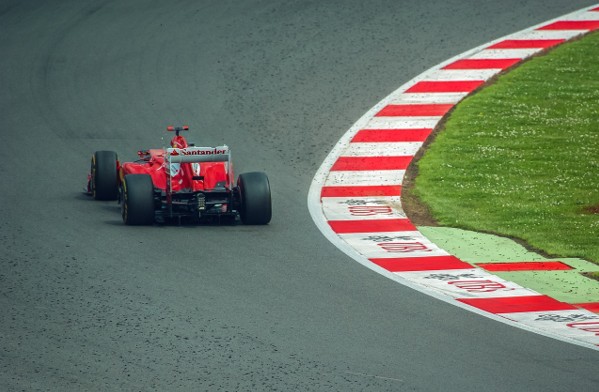
Heading into the 2019 showpiece, Sebastian Vettel had won here four times. However, he knew that he had to make it five if he was to reignite any kind of championship challenge. Mercedes had won all six of the opening races of the season, with championship leader and reigning champion Lewis Hamilton winning four of them. Luckily, however, Ferrari had found the pace they needed, and Vettel took his fifth Montreal pole, two-tenths clear of Hamilton.
For 48 laps, he was imperious. It looked for all the world that he would claim that first win of the season and eat his way into Hamilton’s championship lead. Then, under the Brit’s relentless pressure at the dog-leg Turn 3-4, he ran wide over the grass, rejoined the circuit, and squeezed the Mercedes man into the wall line as he came alongside. Hamilton backed out. The stewards investigated and, with 13 laps remaining, handed Vettel a five-second penalty.
Those 13 laps were among the most agonizing in recent Formula 1 history. Vettel tried — desperately, visibly, furiously — to manufacture five seconds of daylight over a car that had been stapled to his gearbox all afternoon. The delta time never came. Hamilton simply wouldn’t allow it. Vettel crossed the line 1.4 seconds ahead on the road; after the penalty application, Hamilton won by 3.6 seconds — his record seventh Canadian Grand Prix victory. Then came the image that defined it.
Vettel, still in his race suit, climbed from his Ferrari and physically moved the P1 board from Hamilton’s parking bay to his own. Petulant? Human? Both, probably.
It was the act of a four-time world champion who knew, somewhere in his chest, that he’d just lost a race he deserved to win — and that the 2019 title had effectively gone with it. Hamilton’s lead stretched to 29 points over Bottas; Vettel fell 69 adrift. The Circuit Gilles-Villeneuve had delivered its most controversial verdict in a generation, and the argument about whether those stewards were right hasn’t fully died down since.