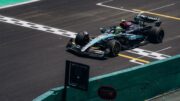
Two extra formation laps, a stalled Racing Bull, and rain that threatened but never came. The 2026 Canadian Grand Prix back in May had every ingredient for an ambush, and for the best part of 30 laps, it looked as though George Russell might spring one.
He’d taken Sprint pole and won the Sprint after a lap-five scrap that left Kimi Antonelli so irate on the radio that Toto Wolff told him to concentrate on driving. Then, the Brit claimed Grand Prix pole too, and it looked for all the world like he would defeat his prodigious young teammate and reignite his championship challenge.
Antonelli’s Montreal Win Breaks Russell’s Spirit
Instead, on race day, the Mercedes pair swapped places, locked brakes, and ran wide, Russell’s lunge at the end of lap six sending Antonelli straight on. McLaren gambled on intermediates and lost; Lando Norris led away, pitted for slicks, and later retired. Then Russell’s power unit failed, and the virtual safety car did the rest, handing Antonelli a fourth straight win that would become five a fortnight later in Monte Carlo.
In the five months since, young Antonelli has gone from strength to strength, and he heads to Austin 102 points clear of a Russell who never recovered from his Montreal heartbreak. Online betting sites now see only one option when it comes to betting on the 2026 F1 world champion. That, of course, is Antonelli, who the latest online sports betting odds make a 1/100 favourite to become the youngest champion the sport has ever seen in a few short weeks.
Make no mistake, his win in Montreal wasn’t an upset. But the Circuit Gilles Villeneuve in Montreal has certainly delivered plenty of those over the years. Here are three of the biggest of them.
Jenson Button – 2011
Five wins from six races. That was Sebastian Vettel’s record in his lightning-quick Red Bull back in 2011, fresh off becoming the youngest world champion ever the previous year. Lewis Hamilton’s victory in China was the lone exception to the German’s reign of terror, and he duly took pole in Montreal, his sixth of the first seven races.
Hamilton qualified fifth, complaining about his seventh-gear ratio, with his McLaren teammate Jenson Button down in seventh. Rain forced a safety-car start, and once racing began, Hamilton tipped Mark Webber into a spin before tangling with his own teammate on the main straight on lap eight.
Hamilton was out. Button collected a drive-through for speeding behind the safety car, and a downpour brought the red flag for more than two hours. Worse followed.
On lap 37 Button clashed with Fernando Alonso, pitted for repairs, and dropped to dead last at the race’s halfway point. He would stay there until lap 40. What does it say about Montreal that a driver can be last on lap 40 and win on the final lap?
On a drying track, Button carved forward, picking off Webber and Michael Schumacher before Vettel slid wide at Turn 6 on the last lap. Four hours, four minutes, and 39 seconds, six safety cars: both of which remain records to this day. Button somehow miraculously won and rose to second in the standings. But in the end, he was powerless to resist as Vettel went on to claim his second of four straight championships in dominant fashion.
Daniel Ricciardo – 2014
Unbeaten in the new hybrid era, Mercedes arrived in Montreal in 2014 with Nico Rosberg four points ahead of teammate Hamilton after Monaco. The German took pole by the slenderest of margins while defending champion Vettel qualified third and his new first-year Red Bull teammate Daniel Ricciardo in sixth. Rosberg squeezed Hamilton at Turn 1, and the safety car appeared before the lap was out after the two Marussias collided.
Then the Silver Arrows began to wilt. Both lost energy recovery, their rear brakes overheating, and Hamilton retired with more than 20 laps left. Rosberg nursed his wounded car towards the finish line, and he remained in the lead for a while with Sergio Perez’s one-stopping Force India sitting on his gearbox.
Red Bull’s stops had jumped Ricciardo ahead of Vettel, and in the closing laps, he drove past Perez and then, three laps from the end, Rosberg. A last-lap crash between Felipe Massa and Perez meant he took the flag behind the safety car. Rosberg left Montreal leading 140-118, but Hamilton won the title in Abu Dhabi, while Ricciardo won again in Hungary and Belgium to finish third in the standings and become the first man to beat Vettel as a teammate.
Robert Kubica – 2008
Three points separated Hamilton from defending champion Kimi Raikkonen heading into the 2008 Canadian Grand Prix, with fellow Ferrari man Felipe Massa a point further back. Robert Kubica, meanwhile, was back at the circuit where a year earlier his BMW had been destroyed on the approach to the hairpin, breaking his leg in the process. Hamilton took pole from Kubica and Raikkonen, Nick Heidfeld in the sister BMW lined up eighth on a heavy fuel load, and the hairpin’s surface was breaking up.
Hamilton pulled clear until Adrian Sutil’s Force India stopped and the safety car came out. The leaders pitted together, and Kubica and Raikkonen halted at the red light at the pit-lane exit to signify that the exit was closed. Hamilton didn’t. He ran into the Ferrari of Raikkonen, and Rosberg then ran into him.
The two-stopping Kubica then needed to pass teammate Heidfeld, which he did on lap 31, and build a gap of roughly 21 seconds; he managed about 24, winning by 16.4 seconds in a BMW one-two, with David Coulthard third in his Red Bull.
Kubica assumed the championship lead, but BMW switched focus to 2009, and he finished the championship in fourth, with Hamilton beating Massa by a point to claim his maiden championship in dramatic fashion.